nepenthes
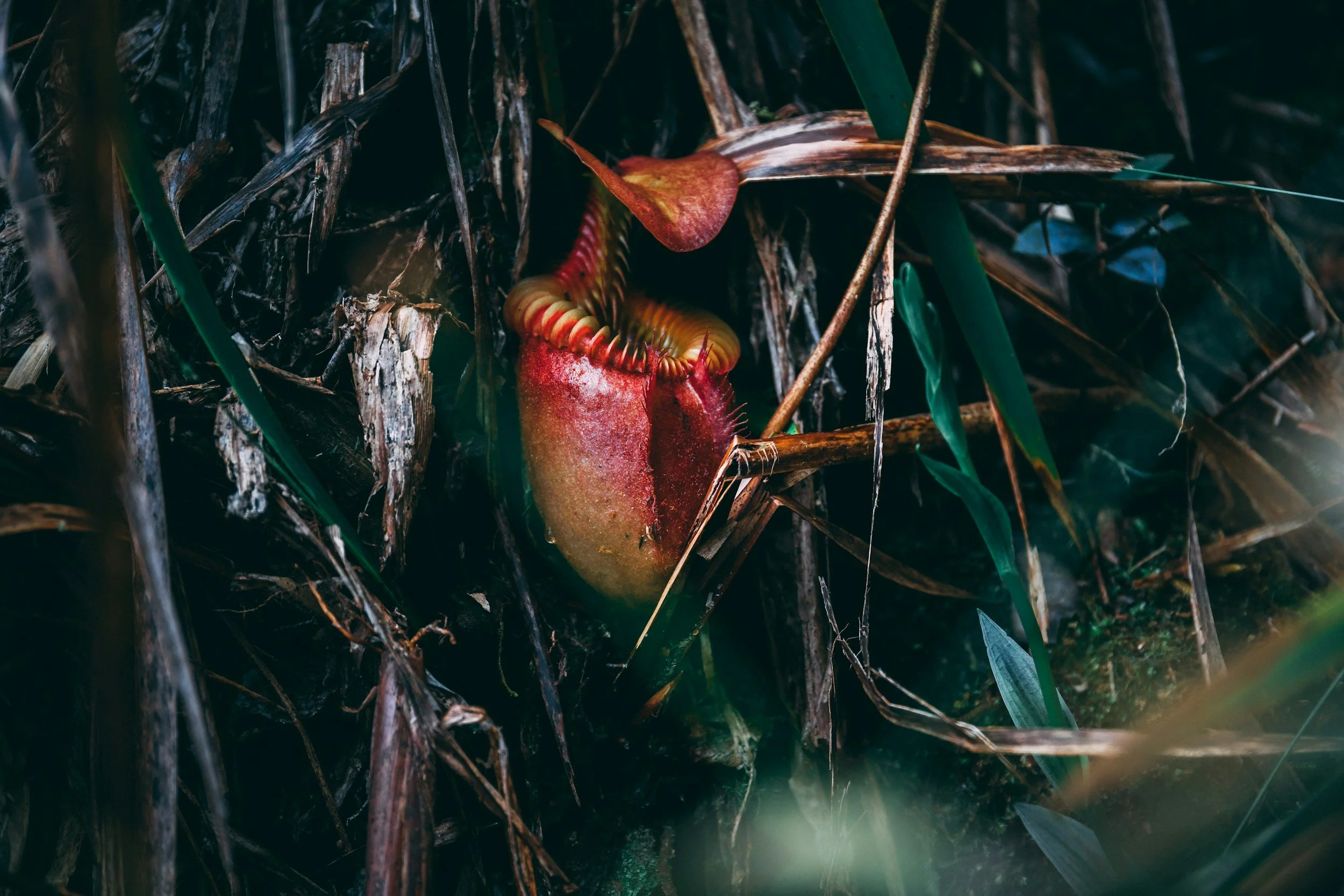
Drifting between earth and sky, Nepenthes are the rainforest’s living chandeliers — elegant, patient, and endlessly captivating.
About Nepenthes
(nih-PEN-theez) • ‘REMOVER OF SORROW’
Across the steaming lowlands and mist-covered mountain ridges of Southeast Asia, a different kind of marvel thrives. From Madagascar and Sri Lanka to Borneo, Sumatra, the Philippines, and Papua New Guinea, the tropical world is home to more than 180 described species of Nepenthes — each one sculpted by evolution into a living work of art.
They climb through trees, cling to cliffs, and sprawl across mossy ground, their tendrils ending in pitchers that dangle like lanterns among the leaves. These are the tropical pitcher plants — patient hunters that have turned the rainforest’s abundance into a delicate balance of lure and trap.
The name Nepenthes comes from ancient Greek — nepenthe, the mythical potion said to banish sorrow. It’s a fitting name: few plants on Earth inspire such calm fascination.
The first written record dates to 1658, when Jacobus Bontius, a Dutch physician in Java, described “a strange plant that catches insects.” By the 18th and 19th centuries, explorers returning from the tropics brought tales — and specimens — of Nepenthes to Europe, sparking a Victorian-era obsession with these mysterious “monkey cups.”
Since then, Nepenthes have become icons of tropical biodiversity — symbols of evolution’s imagination at work
Natural Habitat
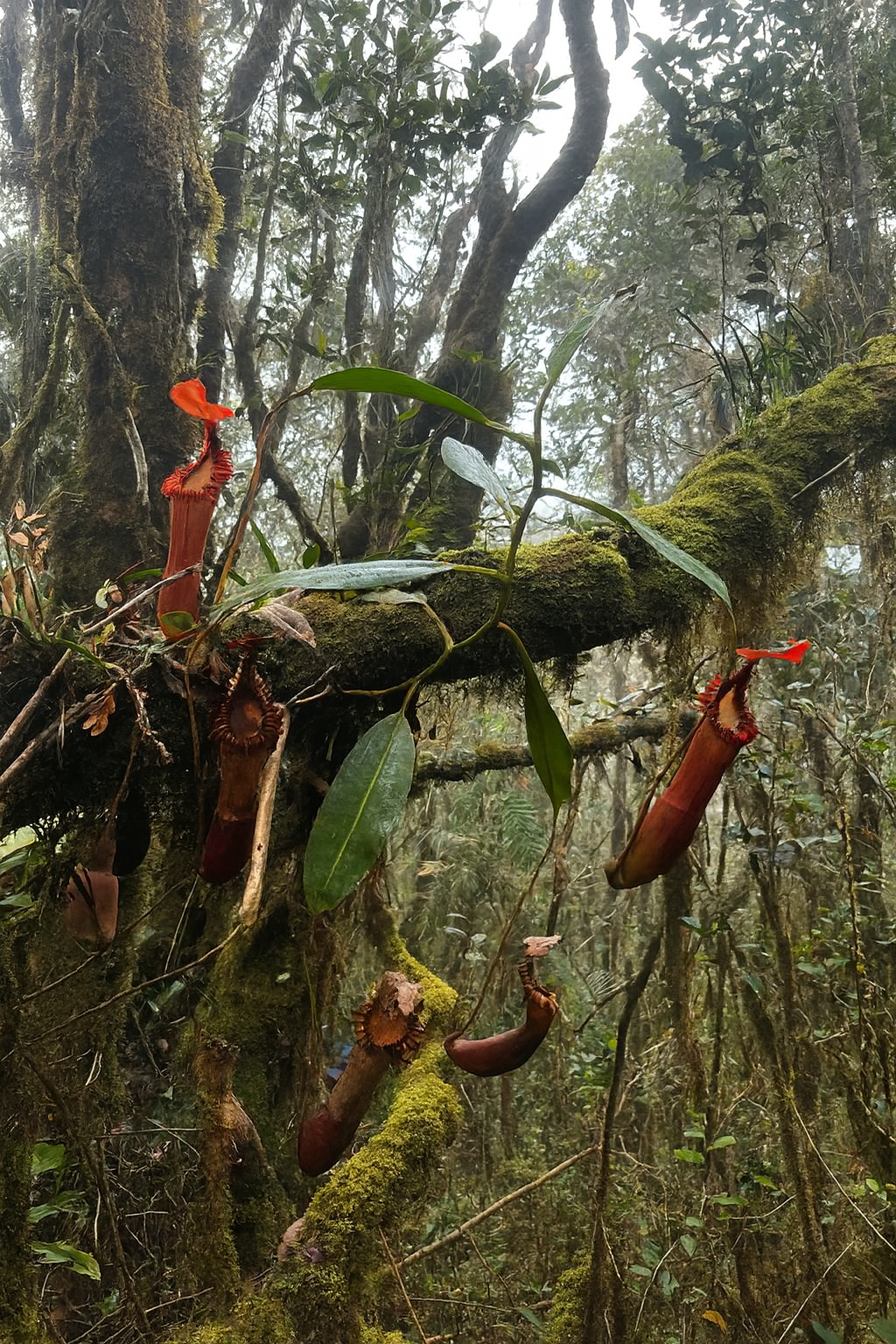
Across the tropical belt of the Old World, Nepenthes flourish in some of the planet’s most extraordinary environments.
From the steaming jungles of Borneo and Sumatra to the mist-wrapped ridges of the Philippines and Papua New Guinea, these plants have mastered the art of survival in places where few others endure.
They grow in soils almost devoid of nutrients — thin layers of moss, sand, or decomposing leaf litter that would starve most vegetation.
In return, the rainforest offers them abundance in another form: endless rain, filtered light, and air so heavy with moisture it seems alive.
Across their range, rainfall can exceed 2,000–4,000 mm a year, creating a world that never truly dries.
Lowland species thrive below 1,000 metres, basking in warmth and humidity, their pitchers glowing in the dim light of the forest floor.
Highland species, by contrast, cling to the cool slopes of mountains up to 3,000 metres, where nights fall to 10–18 °C and mist rolls through the canopy like drifting silk.
Each region tells a different story of adaptation and beauty:
Borneo & Sumatra – the heart of Nepenthes diversity, home to giants like N. rajah and N. lowii.
The Philippines – scattered islands hosting jewel-like endemics such as N. attenboroughii and N. truncata.
New Guinea – rugged terrain shaping vivid, wind-hardened species that thrive in thin, cold soils.
Madagascar & Seychelles – ancient outliers, relics of an early lineage that hint at the genus’s distant past.
From sea level to cloud forest, every Nepenthes is a reflection of its landscape — a living testament to the diversity, resilience, and imagination of the tropical world.
Adaptations to Survival
High above the rainforest, on the mist-shrouded Tepuis, life survives against all odds. The ancient sandstone soils are thin and almost barren, stripped of nitrogen and phosphorus over millions of years. To endure such scarcity, Heliamphora evolved a different strategy — carnivory born of necessity.
Each leaf transforms into a graceful, tubular pitcher, a natural vessel that gathers rainwater and lures passing insects. A narrow slit along the side allows excess water to drain, preventing the traps from flooding during constant downpours. Above each pitcher rises the nectar spoon — a delicate, sculpted appendage that glistens with sweet droplets, reflecting light and scent to entice prey from the mist.
Unlike Nepenthes, Heliamphora do not rely on strong digestive enzymes. Instead, they form symbiotic partnerships with bacteria and protozoa that live within the water-filled traps, quietly breaking down prey over time. It is a slower, more patient form of digestion — a perfect rhythm for a world where nothing moves fast.
To withstand constant cloud and sunlight filtered through mist, many species develop deep red pigmentation, shielding them from ultraviolet radiation and blending with the crimson moss carpets they grow among. Their measured growth mirrors their environment — cool, wet, and timeless — where each new leaf is a testament to endurance.
These quiet adaptations have turned Heliamphora into masters of survival at the edge of the world — plants that thrive where the air thins, the rain never ends, and evolution still whispers through the fog.
Diversity and Uniqueness
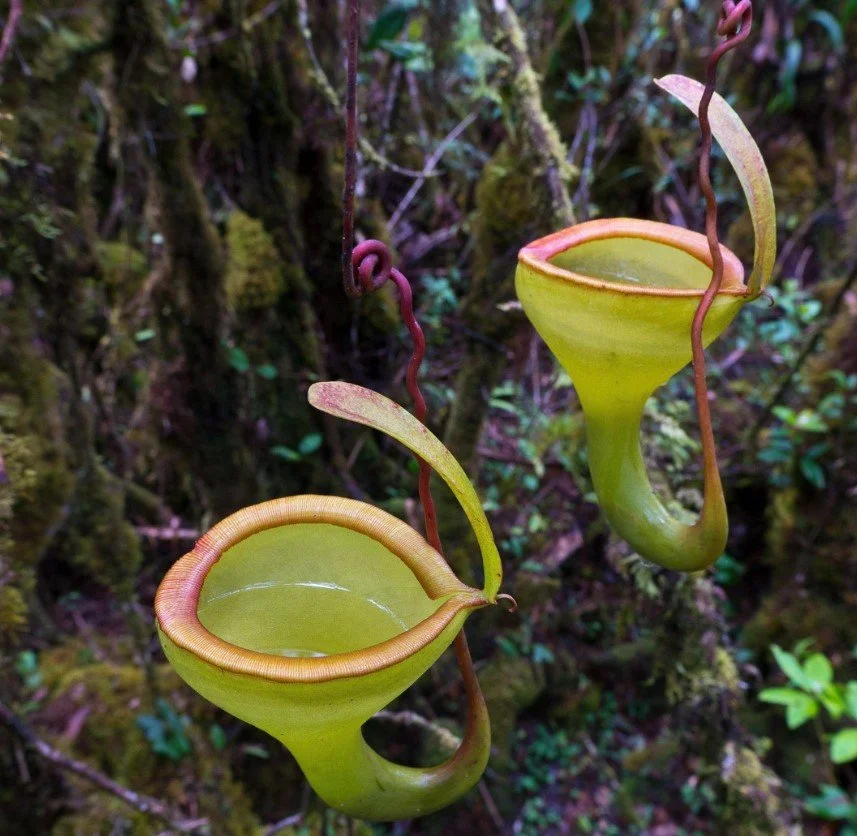
The world of Nepenthes is astonishingly diverse — a family of over 180 described species and dozens more natural hybrids scattered across the tropics of the Old World. From the lowland jungles of Borneo to the mist-veiled peaks of the Philippines and the windswept highlands of Papua New Guinea, no two species are truly alike.
Some, like Nepenthes rajah and N. attenboroughii, produce colossal pitchers large enough to hold small mammals. Others, such as N. campanulata or N. gracilis, form delicate ground rosettes with thimble-sized traps that glisten like jewels in the morning rain.
Their colours span the spectrum — emerald, bronze, scarlet, and near-black — each adapted to the light, humidity, and prey of its unique environment.
Every mountain range, valley, and island has become a world of its own, shaping Nepenthes through millions of years of isolation and adaptation. That’s why collectors often speak of them not as a single genus, but as a universe of living sculptures, each revealing a different expression of nature’s imagination.
And while science recognises around 180 species, new ones are discovered almost every year — proof that even in our modern world, the rainforests still hold their secrets.
Anatomy and Function
Each Nepenthes is a study in movement and transformation, its entire form designed to climb, reach, and capture. From a single stem, long flexible leaves unfurl, each ending in a slender tendril that curls and twists through branches in search of support. At the tip of that tendril, the leaf becomes something extraordinary — a pitcher, alive with colour and form, suspended like a lantern beneath the canopy.
The peristome, or pitcher lip, is ribbed and glossy, a perfect balance of beauty and purpose. It secretes sweet nectar to lure insects, while its polished surface turns treacherous in the tropical humidity, guiding prey toward the liquid below. Inside, the walls are coated with waxy cells that make escape impossible, and the fluid brims with enzymes and surfactants that dissolve and absorb.
Above it all rests the lid, or operculum, a delicate shield that protects the trap from rain while doubling as a beacon of scent and colour. In some species, intricate fringes, teeth, or translucent windows add another layer of deception — each feature an evolutionary refinement for survival.
Beneath the surface, Nepenthes anchor themselves with shallow, fibrous roots, spreading through moss and leaf litter to hold fast in poor soil. Their energy comes not from the ground, but from the countless small lives drawn to the promise of nectar and light.
Whether sprawling as lowland rosettes or climbing over ten metres into the canopy, every Nepenthes embodies grace through design — a living harmony between structure and strategy, shaped by centuries of rain, sun, and adaptation
Reproduction and Flowers
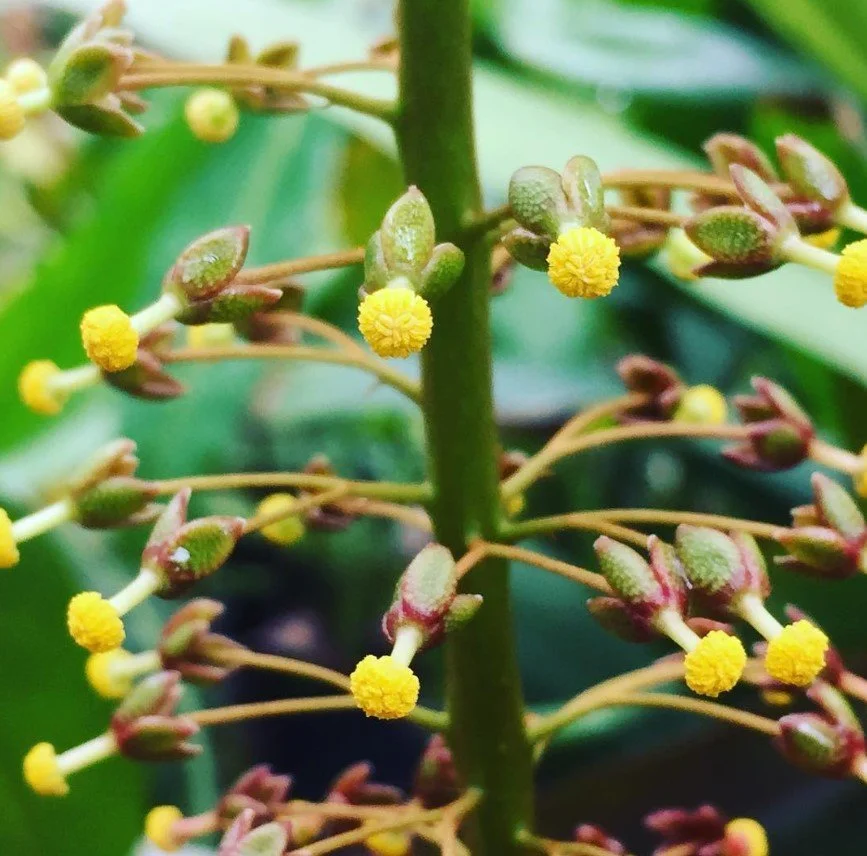
Nepenthes are dioecious, meaning male and female flowers grow on separate plants — a trait that makes breeding and seed production rare in cultivation.
Flowering vines produce long, hanging inflorescences lined with dozens of small, star-like blooms.
Though visually modest, their faint scent draws in a range of pollinators, including flies, beetles, and small wasps.
Pollination occurs through insect visitation, but successful seed set requires both sexes to flower in sync — a timing miracle that may only happen once a year or less.
When pollinated, female plants form elongated seed pods that dry and split, releasing clouds of fine, feather-light seeds carried by wind or rain.
These seeds rarely survive long without moisture, which is why Nepenthes are far more often propagated through cuttings, layering, or tissue culture than from seed.
Propagation in Cultivation
In cultivation, Nepenthes are most often propagated vegetatively — through stem cuttings, basal shoots, or modern tissue culture. Healthy vines are trimmed and rooted in clean, humid conditions, where each cutting slowly awakens into new growth. It’s a process that rewards patience and care, mirroring the rhythm of the rainforest itself.
Tissue culture has become the cornerstone of sustainable propagation, allowing rare species and hybrids to be multiplied without disturbing wild populations.
Through this method, growers can preserve genetic diversity while ensuring that each plant’s unique traits — colour, form, and temperament — are passed on faithfully.
While cloned plants maintain stability, seed-grown Nepenthes hold a special place among collectors.
No two are ever the same; each seedling carries its own fingerprint of evolution, a blend of subtle differences shaped by chance and time.
Raising them from seed is an act of dedication — slow, uncertain, but deeply rewarding — a way of watching nature’s creativity unfold leaf by leaf, pitcher by pitcher
Why They Are Unique
Each species of Nepenthes tells a story of adaptation — a tale written in rain and sunlight. Spread across islands, mountains, and valleys, these plants evolved in isolation, each shaped by the rhythms of its own world. No two species are the same: some hang like lanterns in the canopy, others sprawl across moss and stone, each design a unique answer to the same question — how to survive where others cannot.
This diversity has made them icons of evolution’s imagination — proof that nature, given time and hardship, creates beauty through necessity. From giants capable of trapping small animals to delicate miniatures that live among mosses, Nepenthes reveal the endless creativity of the tropics.
To grow one is to hold a fragment of that wild abundance — a piece of the rainforest’s pulse, its heat and rhythm, its quiet intelligence. Every pitcher tells its own story: of rain that never stops, of sunlight that never fades, and of life finding wonder in even the harshest places
Ecological Role
Far from being mere insect traps, Nepenthes are keystones of their ecosystems.
Each pitcher functions not just as a means of survival, but as a microcosm of rainforest life — a living vessel that supports entire communities of organisms.
Their fluid-filled traps host complex microhabitats inhabited by insects, mites, spiders, frogs, and even small mammals.
Inside, these creatures form delicate food webs: mosquito larvae filter the liquid, while bacteria and protozoa recycle organic material, turning each pitcher into a self-sustaining world suspended between plant and animal life.
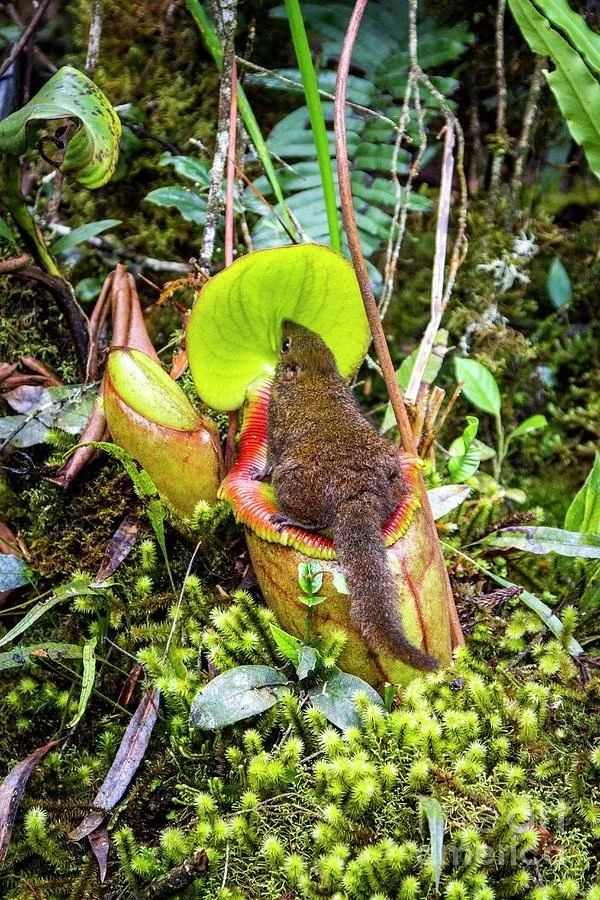
Some species, like N. lowii and N. rajah, have evolved even further — forming unique relationships with tree shrews and mountain rodents. Instead of relying solely on digestion, they collect nutrients from animal droppings, a remarkable partnership of adaptation and coexistence. In return, the animals gain a steady source of nectar, transforming predator and prey into unlikely allies of survival.
Highland species in particular contribute to the fragile nutrient cycles of their mountain ecosystems, capturing trace minerals and redistributing them through decaying leaves and rainwater run-off. Even after a pitcher dies, its remains enrich the soil — continuing to nourish the forest floor long after its final trap closes.
Each Nepenthes pitcher is therefore more than a marvel of design; it’s a self-contained ecosystem, a pocket of life within life. They remind us that in nature, even the hunters can nurture — turning the act of predation into an elegant expression of balance.
Conservation
Across the tropics, many Nepenthes species now stand on the edge of survival. Expanding agriculture, mining, and deforestation continue to erase the fragile forests and mountain slopes they call home. For species confined to a single peak or island, the loss of even a few hectares can mean extinction — the disappearance of a form that took millions of years to perfect.
Illegal collection adds further strain, feeding a demand that too often forgets the fragility behind the beauty. Yet, amid this challenge, there is hope.
Conservationists, botanists, and dedicated growers around the world now work together to protect these plants — through seed banking, tissue culture, and habitat preservation. Their efforts ensure that the rainforest’s living jewels are not only admired but safeguarded for generations to come.
Every Nepenthes cultivated in care reduces pressure on the wild, becoming an ambassador for its home — a fragment of the rainforest that continues to breathe, thrive, and inspire far beyond the jungle it came from.